
Hydroseeding & hydraulic mulch for utility-scale sites.
Hydraulic mulch, bonded fiber matrix and Flexterra HP-FGM, applied to spec by crews that work the 14-day stabilization clock every week. Measured from your civil set, so acres on the proposal match acres on the ground.

The right product for the slope, not the cheapest one.
Hydraulically applied erosion control comes in grades, and the grade is set by the slope, the soil and how long the area has to hold before vegetation takes over. We stock and apply all of them, and we quote the one the plan calls for.
Hydraulic mulch covers and holds seed on flat to gentle ground where the risk is drying out, not washing out. Bonded fiber matrix (BFM) bonds to the soil surface for moderate slopes and channels; it needs a cure window before rain. Flexterra HP-FGM is the top of the range: a flexible growth medium that gives immediate erosion protection on steep slopes, basin sides and critical areas, with no cure time. We also run ProGanics on poor subsoils where there is no topsoil to work with.
Every product goes down at the manufacturer's application rate, with the tackifier and seed mix the spec calls for. We don't water it down to stretch a tank.
Steep slopes, basin side slopes, swales, anything that has to hold through the next storm. Immediate protection, no cure time.
Moderate slopes and large open areas with a dry window before rain. Lower cost per acre than FGM.
Flat ground and temporary cover between phases. Seed, mulch, tackifier in one pass.
Biotic soil media where topsoil was stripped or never existed, so seed has something to grow in.
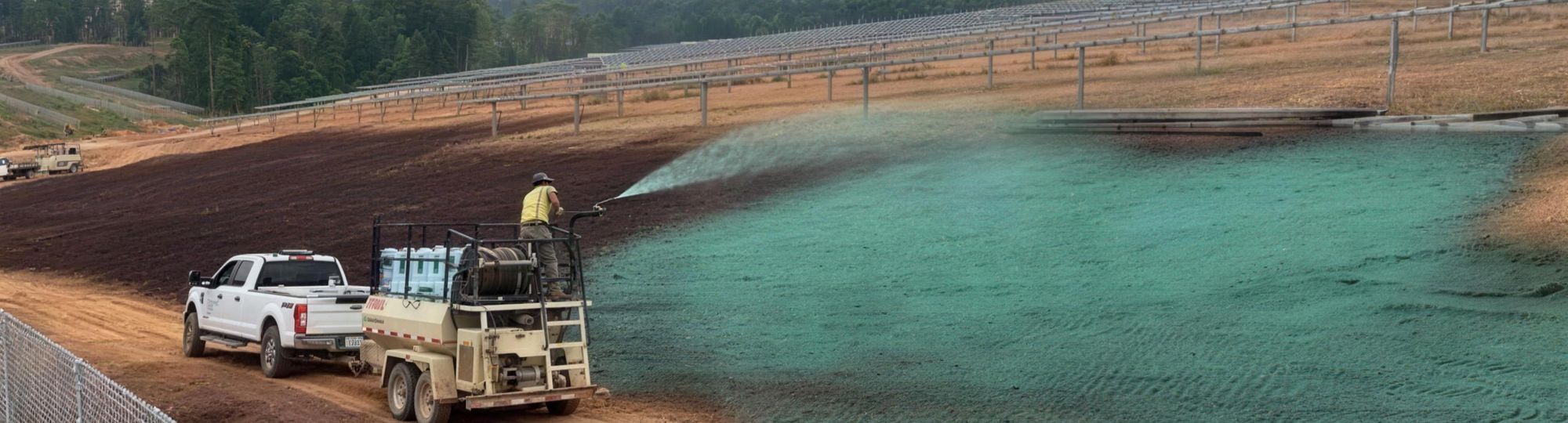
Measured, phased, documented.
Send the civil set or a KMZ. We measure basins, swales, buffers and disturbed areas and return a quantity-based proposal, usually within two business days. The number on the proposal is the number of acres we will spray; if the site changes, the change order is measured the same way.
On solar sites we follow grading release by block, not by the whole site: basin side slopes and swales first, then the 30-foot buffers along wetlands and fence lines, then the rows. Temporary seeding covers phased areas that will be disturbed again; permanent seeding with the project's PLS mix goes on final grade.
The superintendent gets a daily production report with photos by area, so there is never a question of what got sprayed and when. At closeout we hand over the documentation the SWPPP and the Notice of Termination need.
Basins, swales, buffers, disturbed areas measured from plans and KMZ. Acres on paper match acres on the ground.
Spray rig, water and material arrive on our own trucks and trailers. We mobilize immediately.
Production report with photos every day. Clean records for inspections and the NOT.
Stabilization begins immediately when grading stops and finishes inside the permit window. Seven days in sensitive waters.
Straight answers.
What is the difference between hydraulic mulch, BFM and FGM?+
How many acres can you spray in a day?+
How long until it's green?+
Do you supply the seed mix?+
Do you do temporary and permanent seeding?+
Send the plans. We'll send a number.
Quantity-based proposals, measured from your civil set. Response within 2 business days.